

Low-Code Hits 75%: Is the Era of "Everyone's a Developer" Finally Here?
Here's a stat that stopped me mid-scroll: Gartner now says 70% of new enterprise applications use low-code or no-code technologies. That's up from less than 25% just three years ago. The global low-code market is projected to hit $44.5 billion this year, and 80% of the people using these tools aren't even in IT departments.
So yeah, the "everyone's a developer" era isn't coming. It's here. But before you cancel your engineering budget, let's talk about what that actually means, because the full picture is a lot more nuanced than the headlines suggest.
What Low-Code Actually Is (And Isn't)
Low-code and no-code platforms (think Bubble, FlutterFlow, Retool, Lovable) let you build software using visual interfaces instead of writing code line by line. Drag a button here, connect a database there, set up some logic, and you've got a working app.
I'm excited about it. The idea that someone with a great business idea can actually prototype it without spending $50K upfront? That's a big deal. It unlocks abilities for people who were previously locked out of building software, and that kind of democratization should drive real innovation.
But here's the thing: there's a massive gap between "I launched something" and "I built something that scales." And that gap is where a lot of people are getting burned.
Where Low-Code Actually Shines
I'll be the first to say it: for the right use case, low-code is a no-brainer.
Validating an idea fast. If you're a founder with a concept, spending $500 to $5,000 on a no-code MVP to test if anyone actually wants it? That's just smart. Way better than burning months and tens of thousands on custom development before you even know the idea works.
Internal tools. Admin panels, dashboards, workflow automations. Retool has basically nailed this. It makes zero sense to custom-build an internal expense tracker when a low-code tool can do it in a day.
Quick prototyping. Even for those of us who write code for a living, spinning up a low-code prototype to test a user flow is just... efficient. No shame in it.
The "Easy" Trap Nobody Talks About
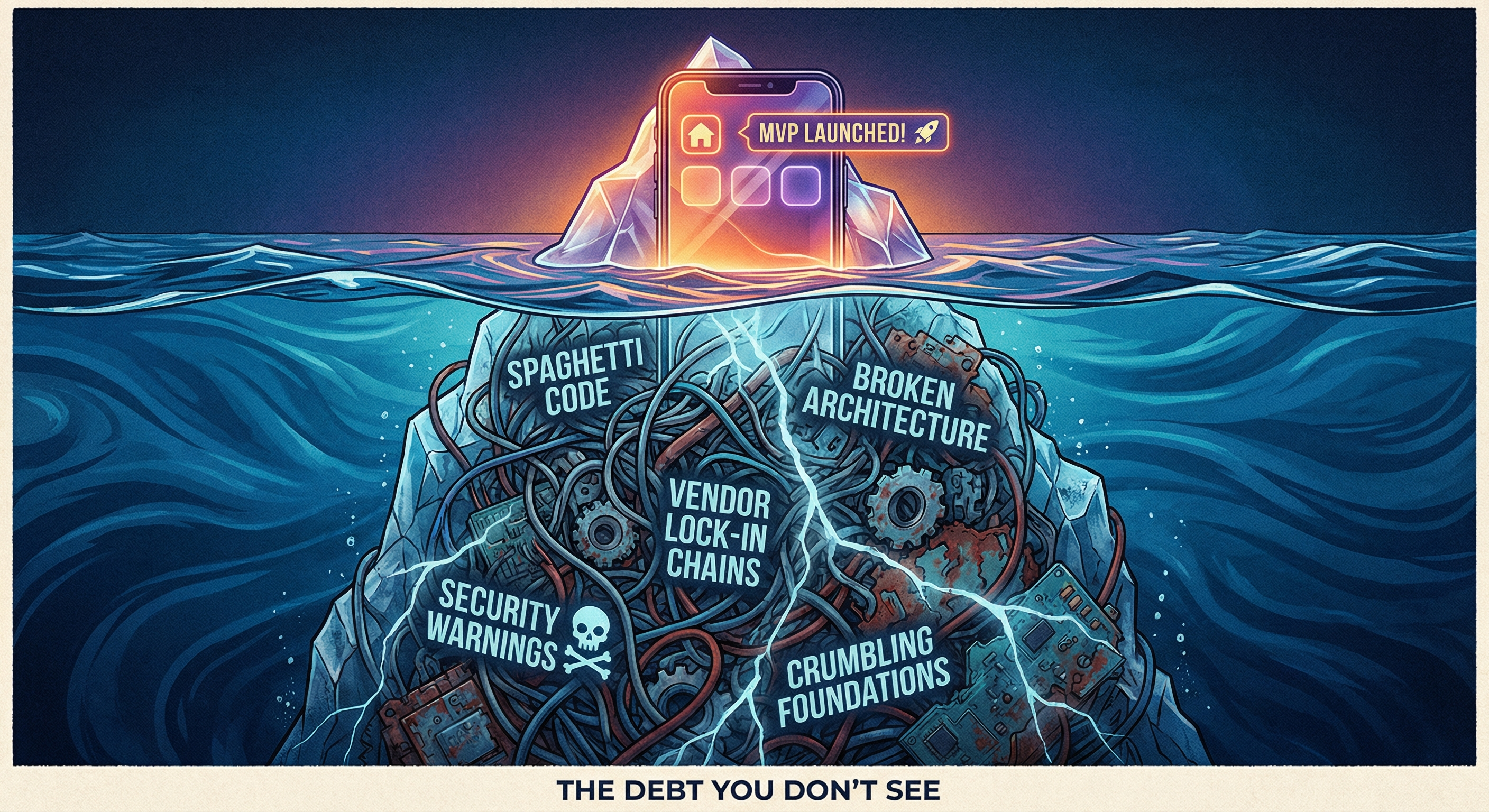
Now here's where my enthusiasm gets a reality check. 39% of business leaders already report limited customization as a significant challenge with low-code platforms. That number feels low to me.
The problem isn't that low-code is bad. The problem is that it creates a false sense of "easy." I've seen this pattern play out over and over:
A founder launches an MVP on a no-code platform. It works. Users show up. Revenue starts trickling in. Great! Then they need a custom feature the platform doesn't support. They need better performance because the app is lagging under real load (over 50% of FlutterFlow users have reported performance issues). They need proper security and compliance because they're handling real user data.
And suddenly they're staring down a full rewrite.
People think building is the hard part. It's not. Maintaining, scaling, and evolving is where the real complexity lives. Low-code hides that complexity instead of eliminating it. Skip the fundamentals (architecture, security, data modeling) because the tool abstracts them away, and you're quietly accumulating technical debt you can't even see. That's the part that keeps me up at night.
Low-Code Is the New WordPress (And That's Not an Insult)

Here's my hot take: low-code is following the exact same trajectory as WordPress.
WordPress powers roughly 40% of the internet. It's incredible for blogs, small business sites, and content-heavy projects. But nobody's building Spotify on WordPress. It found its lane, and it's a massive, valuable lane.
Low-code is heading to the same place. It'll power a huge chunk of applications (internal tools, MVPs, simple customer-facing products) and that's a good thing. But the apps that define industries, the ones handling millions of users, sensitive data, and experiences that differentiate a business, those will still need custom engineering.
The 75% stat from Gartner is real, but a bit misleading. The 25% that don't use low-code? Those are the ones driving competitive advantage.
Oh, and AI Is About to Scramble Everything
One more wrinkle: the line between "low-code" and "real code" is getting blurry fast. Tools like Lovable, Cursor, and Bolt are part of a new wave called "vibe coding." Describe what you want in plain English, get working code back. 84% of developers now use or plan to use AI coding tools, and enterprise adoption grew 340% since 2024.
I think this eats into traditional low-code within a couple of years. Why use a constrained visual builder when you can tell an AI what to build and get actual, exportable code?
But the same "false sense of easy" applies here too. Maybe even more so. Low-code platforms at least have guardrails. AI-generated code can look perfect and still have architectural problems that won't surface until you're scaling.
So What Does This Mean for You?
If you're a founder or a business leader trying to figure out the right move, here's how I'd think about it:
If you're still validating your idea, low-code is your friend. Build fast, learn what users want, don't over-invest. You can always rebuild later.
If your software IS your product (the thing customers pay for, the thing that differentiates you), be very careful about building your core on a platform you don't control. 62% of IT decision-makers are already concerned about vendor lock-in, and for good reason. You can't export your Bubble app as clean code. If you outgrow the platform, you're starting over.
If you're somewhere in between, the hybrid approach is worth considering. Use low-code for the parts that don't need to be special (internal tools, admin panels, landing pages) and invest in custom development for the parts that do. That combo can save 30-50% compared to going full custom from day one.
The question was never really "should I use low-code?" It's "what am I building, and what stage am I at?" The answer depends entirely on that.
Where This Is Headed
Don't confuse easy-to-start with easy-to-scale. That's the core lesson of the low-code era. These tools are powerful, and they're opening the door for more people to build more things than ever before. I think that's worth celebrating.
But the businesses that win long-term will be the ones that know when to start with low-code, and when to graduate from it. The 75% stat is real. The question is whether your product belongs in that 75%, or in the 25% that needs something more.
My bet? We're about to see a massive wave of companies that launched on low-code and are now realizing they need to rebuild. And that's not a failure. That's just the natural next step.
Solac Labs helps startups and businesses build web and mobile apps. If you're weighing your options between low-code and custom development, we'd love to talk through it with you. Get in touch.
Comments (0)
No comments yet. Be the first to share your thoughts!
Related Posts


The Rise of Agentic AI: Your Software Is Learning to Do Things on Its Own
The rise of agentic AI - just a normal guy's opinion