
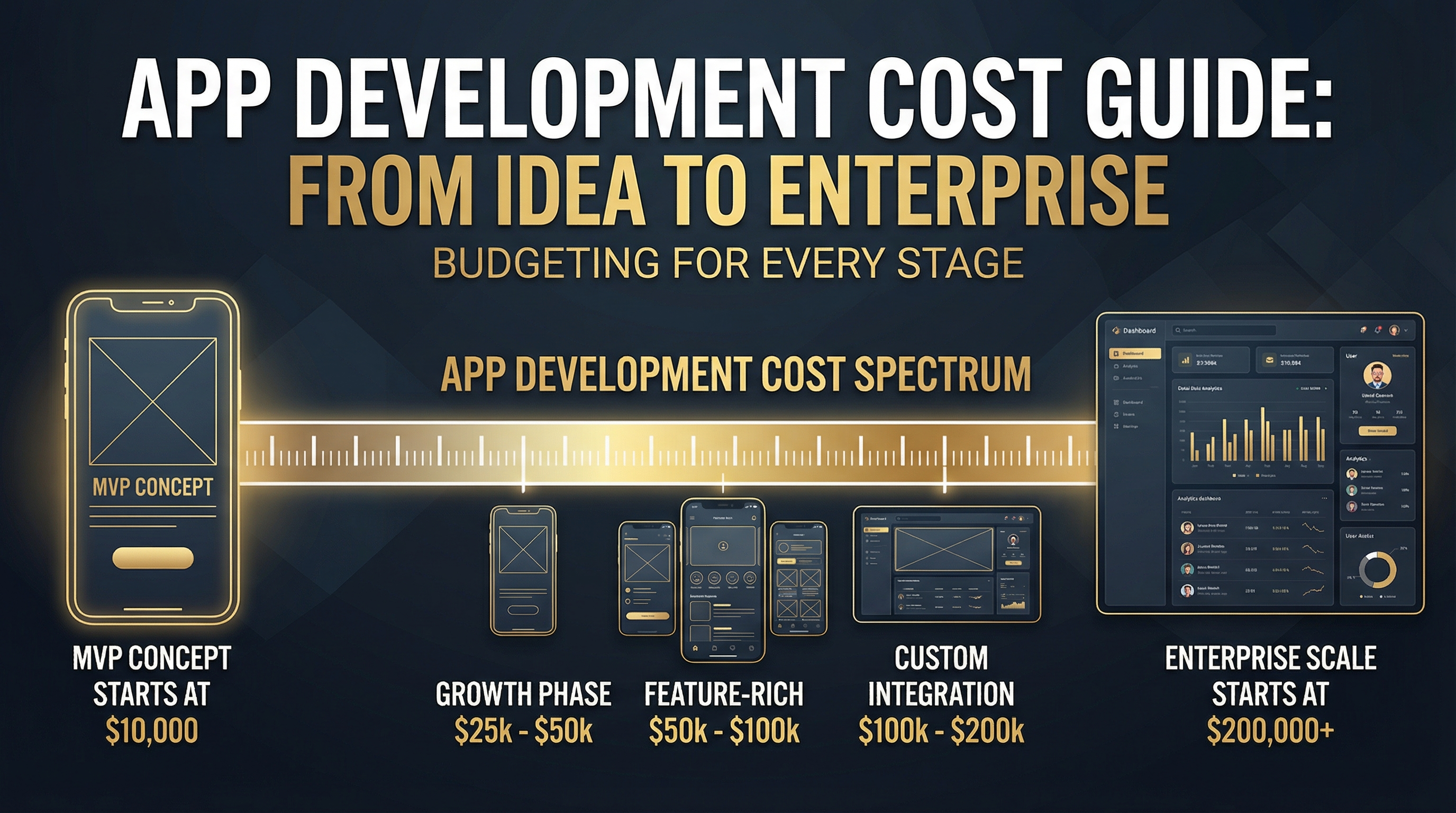
How Much Does It Actually Cost to Build an App in 2026?
"How much does it cost to build an app?" I get some version of this question constantly. And I'll be upfront: the answer ranges from $5,000 to over $500,000. Wild range, right? But the reason it's that wide is exactly what makes this worth breaking down, because the real question isn't "how much?" It's "how much for what stage, and what are you actually paying for?"
Let me walk you through it.
The Quick Numbers
Before we get into the nuance, here's the landscape based on a 2026 GoodFirms survey of 267 app development companies:
By complexity:
Simple app or MVP: $5,000 to $25,000
Moderate app (user auth, API integrations, custom design): $25,000 to $100,000
Complex app (marketplace, real-time features, payments): $100,000 to $300,000
Enterprise-grade (AI features, multi-region, compliance): $300,000 to $500,000+
By who builds it:
Freelancer: $12,000 to $35,000 for a standard MVP
Agency: $35,000 to $120,000 for the same scope
In-house team: $80,000+ (salaries, benefits, overhead)
No-code tools: $3,000 to $15,000 per year
Those numbers tell you what things cost. They don't tell you what you should spend. That part depends on where you are in your journey.
The Mistake That Costs Founders the Most Money
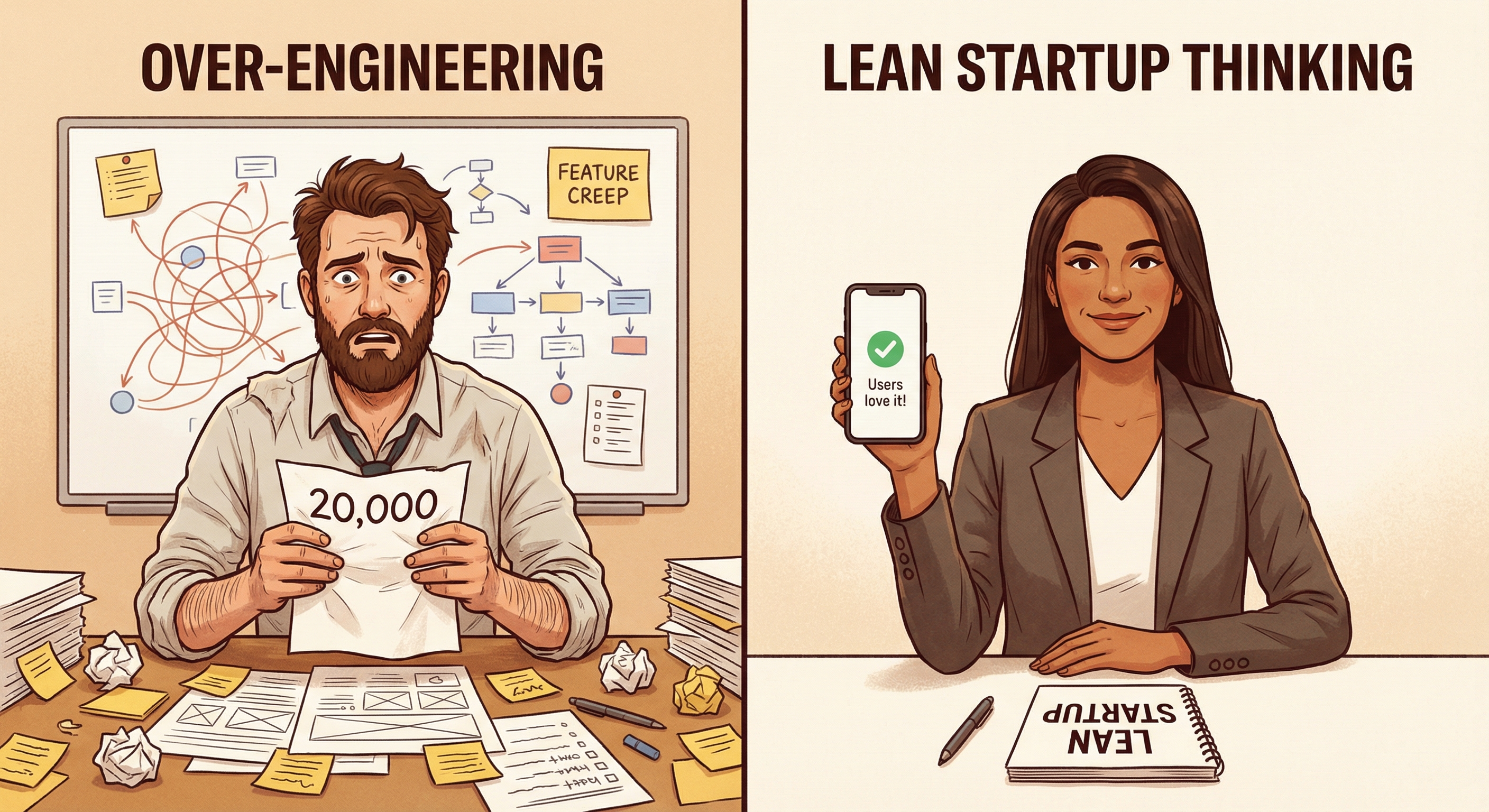
I've watched this play out with personal projects, and I've seen it in every founder community I follow: building too much, too soon.
It usually looks like this. A founder has a vision for their app. They want user profiles, payment processing, push notifications, an admin dashboard, social sharing, analytics, maybe some AI features. They want it on iOS AND Android. They want it to look like the apps they use every day (Uber, Airbnb, Instagram), forgetting those apps had hundreds of engineers and years of iteration to get there.
So they get a quote for $120K, panic, and either try to build it all with a $15K freelancer (who delivers something half-finished) or drain their savings on a V1 that nobody ends up using because they never validated whether anyone wanted it in the first place.
The better move? Start lean. Prove the idea works with a $5K to $25K MVP that does one or two things well. Then invest real money once you know what your users actually need, not what you assumed they would.
What You're Actually Paying For
Most cost breakdowns give you a number and move on. That's not enough if you want to evaluate quotes intelligently. Here's roughly where your money goes, based on industry benchmarks from Appinventiv:
Design (15-25% of budget): This isn't just making things pretty. Good UI/UX research and design determines whether people can actually use your product. Skipping this is one of the fastest ways to waste your development budget on features nobody can find or understand.
Development (40-55%): The actual building. This is where platform choice matters. Going native (separate iOS and Android apps) roughly doubles this cost. Cross-platform frameworks like Flutter or React Native save 30-40% by sharing most of the code across platforms, and in 2026, they're good enough for the vast majority of apps.
QA and Testing (10-20%): Finding bugs before your users do. Cutting this to save money is tempting and almost always backfires.
The rest: Project management, deployment, third-party integrations, and the part everyone forgets...
The Bill After Launch (What Caught Me Off Guard)
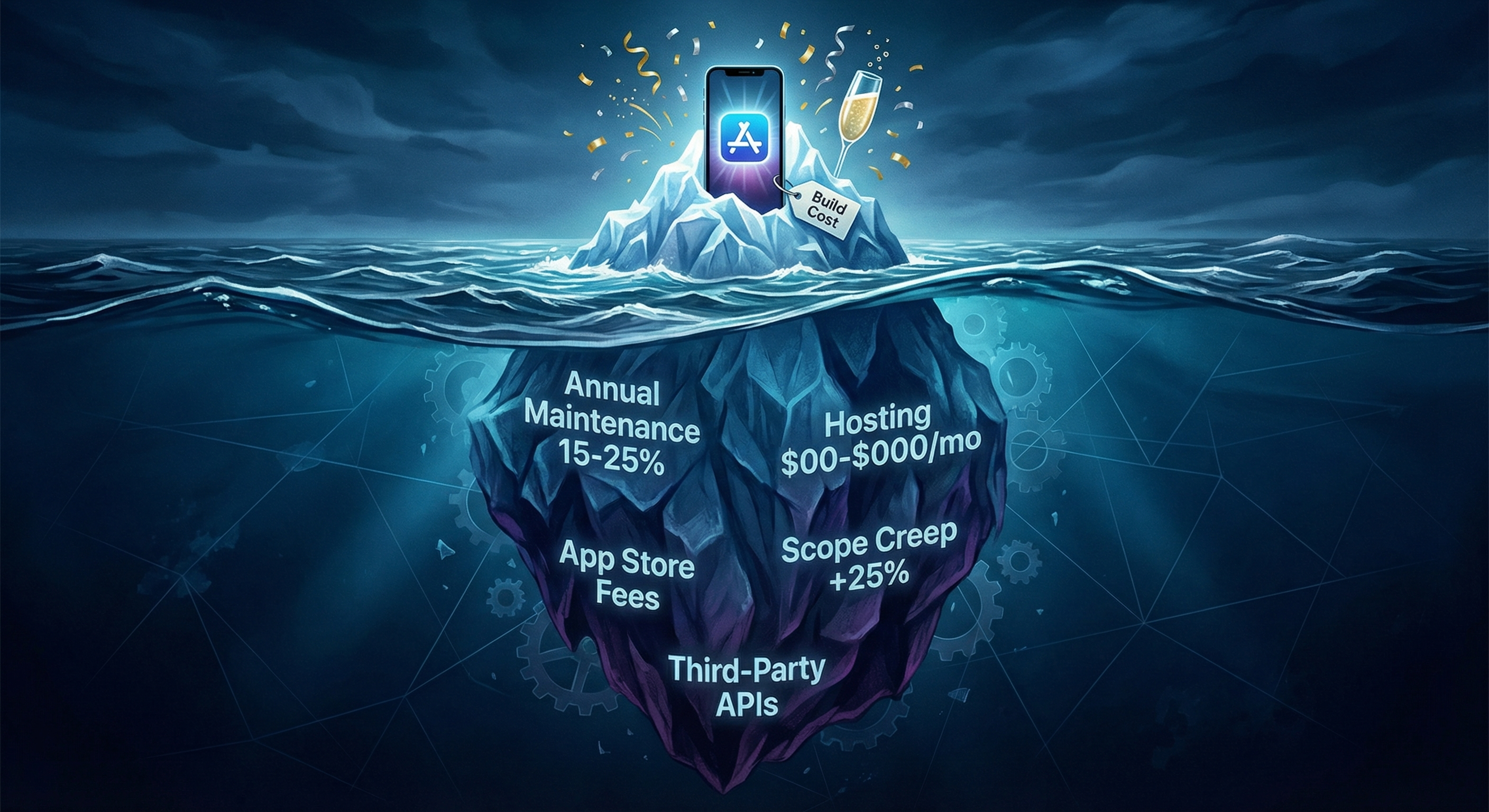
This is the section I wish someone had shown me before I shipped my first project. The build is not the finish line. It's the starting line.
Maintenance alone runs 15-25% of your original build cost every year. Built a $100K app? Budget $15K to $25K annually just to keep it running, patched, updated, and compatible with the latest OS versions.
On top of that:
Hosting: $50 to $500/month at early stage, scaling to $500 to $5,000+ as you grow
App store fees: Apple charges $99/year plus a 15-30% cut of in-app purchases. Google takes a $25 one-time fee plus similar commission
Third-party services: Stripe for payments, Twilio for messaging, mapping APIs, analytics tools. These scale with your user base
Scope creep: GoodFirms found it adds 10-25% to project costs, and it sneaks up on almost every project
If you budget only for the build and nothing for what comes after, you're setting yourself up for a hard conversation about six months post-launch.
The AI Factor (It's Complicated)
You've probably heard that AI is making app development cheaper. That's partially true. A March 2026 GoodFirms survey (covered by Yahoo Finance) found that 91% of software companies now use AI tools in their workflow, and 61% expect it to reduce project budgets by 10-25%.
But here's what I think most articles get wrong about this: AI has made bad apps cheaper. You can vibe-code a prototype for under $300 with tools like Lovable or Bolt. That's remarkable. But a quality, scalable, secure product still requires experienced humans making thoughtful decisions about architecture, security, and user experience.
Think of it like this: AI is a power tool, not a replacement for the carpenter. It makes skilled teams faster and more efficient. It doesn't turn a $5K budget into a $100K product.
So What Should You Actually Spend?
It depends on what you're building. (I told you that answer was coming.)
If you're validating an idea: $5K to $25K. Use no-code tools or a lean custom MVP. Your only goal is to prove people want this. Anything beyond that is premature.
If you have validation and need a real product: $30K to $120K with an agency or strong freelance team. This gets you a solid V1 on one or two platforms with core features, proper architecture, and room to grow.
If you're scaling something that's already working: $100K+. This is where you invest in performance, security, scalability, and the features that differentiate you from competitors.
The founders who spend wisely aren't the ones with the biggest budgets. They're the ones who match their spending to their stage.
How Solac Labs Can Help
We build web and mobile apps for startups and growing businesses. If you're trying to figure out what your project would actually cost, we'll walk you through it with the same transparency you just read in this post. No inflated quotes, no hidden fees, no pushing you toward a bigger build than you need.
Whether you're at the "I have an idea" stage or the "we have users and need to scale" stage, we'd love to help you scope it out.
Where This Is All Headed
Start lean, scale smart. That's the playbook.
The cost of building an app in 2026 is both lower than ever (thanks to AI, cross-platform frameworks, and better tooling) and higher than most people expect (because maintenance, hosting, and iteration never stop). The founders who navigate this well are the ones who understand that app development isn't a one-time purchase. It's an ongoing investment in a product that grows with your business.
Know what stage you're at. Spend accordingly. And budget for the whole journey, not just launch day.
Sources for this article include the GoodFirms 2026 App Development Cost Survey (267 companies), the GoodFirms Custom Software Development Cost Survey (March 2026, covered by Yahoo Finance), Appinventiv, Ideas2IT, Natively, and DiscreteLogix.
Comments (0)
No comments yet. Be the first to share your thoughts!